Leaf
Margaux Husson, Tela Botanica · CC BY-SA 2.0
Balkan clary
Salvia nemorosa L.
Also known as: Woodland sage
Family: Lamiaceae
40 to 60 cm tall
Grown in sunny borders and beds, also found in dry meadows
Flowering: June – August
Full sun
Very hardy, to about -25°C
❓ How do you recognise this plant?
Woodland sage flowers a second time if its faded spikes are cut back to the base after the first flowering — pruning that extends flowering by several more weeks. Woodland sage has small violet-blue flowers packed in a dense, continuous spike, with coloured bracts that persist even after the petals have fallen, and leaves borne all along the stem, whereas meadow clary has larger bright blue-violet flowers, more widely spaced in loose whorls, and its leaves are mostly grouped in a basal rosette.
🍃 Leaves
Opposite, ovate, crinkled, aromatic when crushed
🌸 Flowers
Small, violet-blue, grouped in dense erect spikes
🍎 Fruits
Small achene
🪵 Bark
Square, erect herbaceous stem, perennial from its rootstock
🗺️ Distribution
Native to central and eastern Europe; widely grown in France as a border perennial
🐝 Value for pollinators
Very nectar-rich spikes, one of the most attractive perennials for bees and bumblebees in midsummer
✂️ Horticultural uses
Border and rock garden perennial, planted in large clumps for its dense violet spikes, reflowers if cut back after the first flowering
⚠️ Possible toxicity
No known toxicity
🌱 Known cultivars
'Caradonna'
The cultivar 'Caradonna' is recognised by its almost black flowering stems bearing intense violet spikes, a much stronger contrast than the duller foliage and flowers of the wild species. Introduced by the German nursery Zillmer Pflanzen, it received the RHS Award of Garden Merit in 2012.
⚠️ Look-alike species
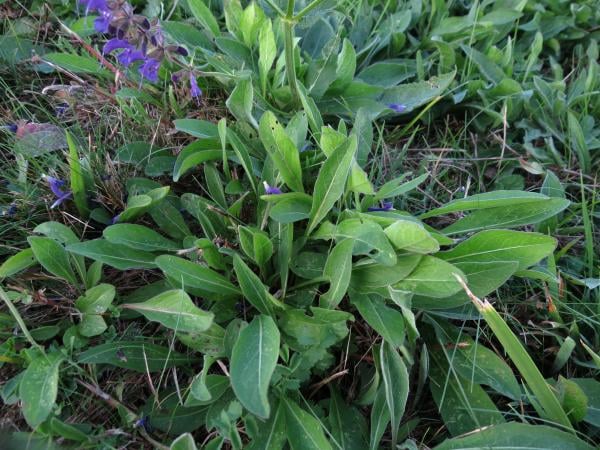
Balkan clary
Salvia nemorosa
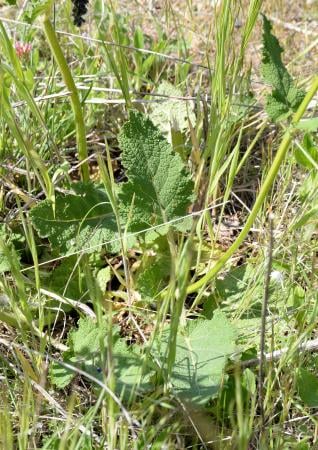
Meadow clary
Salvia pratensis
Woodland sage has small violet-blue flowers packed in a dense, continuous spike, with coloured bracts that persist even after the petals have fallen, and leaves borne all along the stem, whereas meadow clary has larger bright blue-violet flowers, more widely spaced in loose whorls, and its leaves are mostly grouped in a basal rosette.
🌿 Other Lamiaceae to discover


ℹ️ Educational profile — do not use it to judge whether a plant is edible or safe.
🌱 This database is constantly evolving — species and information are added and corrected regularly. Spotted a mistake? Report it below.
© Floraneo — profile content is protected; reproduction without permission is prohibited. Photos remain under their own licence (see the credit shown on each photo).