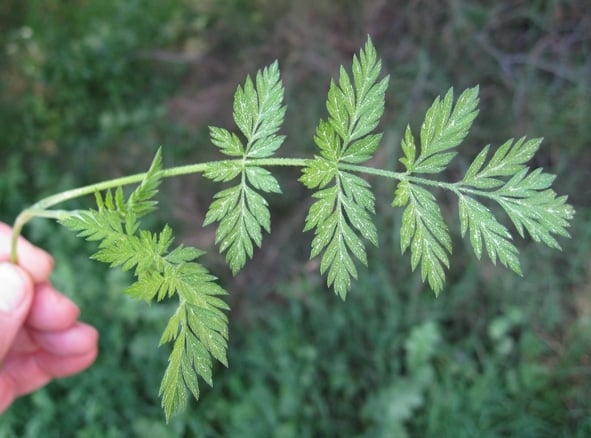
It is one of the first umbellifers to flower in spring: from April it lines roads and banks with great white lace, hence its English name of cow parsley. Cow parsley has a green stem, slightly hairy at the base and unspotted, leaves with a mild scent and smooth black fruits; poison hemlock, deadly, has a hollow stem spotted with purple and hairless, leaves with a foul mouse-like smell and rounded fruits with wavy ribs. Never rely on a single criterion.
🍃 Leaves
Cut three times into fine lobes, 10 to 30 cm, dark green, glossy, with hollow sheaths along the stem, mildly scented
🌸 Flowers
Small white flowers in umbels 3 to 6 cm across with 6 to 15 rays, with no collar of bracts at the base of the big umbels
🍎 Fruits
Small elongated fruits 7 to 10 mm long, black, shiny and smooth, with a short beak
🌿 Stem and habit
Upright, hollow, ridged stem, slightly hairy at the base, green and not spotted with purple
Distribution, pollinators, uses▾
🗺️ Distribution
Europe, Asia and North Africa; naturalised in North America
🐝 Value for pollinators
Early flowering, much visited by flies, beetles and bees; host plant of many caterpillars
✂️ Horticultural uses
Plant of banks and flower meadows, very visible in spring along roads
⚠️ Possible toxicity
Easily confused with deadly umbellifers (hemlock, hemlock water-dropwort); not to be eaten without absolutely certain identification
Cow parsley has a green stem, slightly hairy at the base and unspotted, leaves with a mild scent and smooth black fruits; poison hemlock, deadly, has a hollow stem spotted with purple and hairless, leaves with a foul mouse-like smell and rounded fruits with wavy ribs. Never rely on a single criterion.
Cow parsley flowers early, from April to June, with glossy leaves that do not smell of carrot and umbels with no dark flower in the centre; wild carrot flowers from June to September, with a small dark red-black flower in the centre of the umbel, three-pronged bracts under the umbel and a carrot smell.