Foxglove or Common comfrey: how to tell them apart?
Foxglove and Common comfrey look alike and are often mixed up. Here is how to tell them apart, feature by feature, with their photos and the details to look for.
⚡ The quick answer
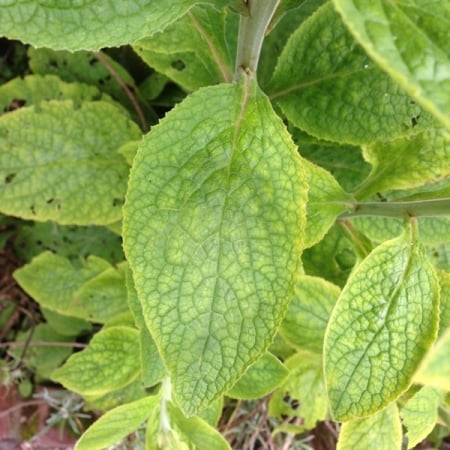
Foxglove
Digitalis purpurea
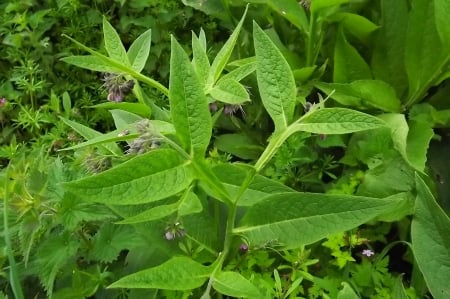
Common comfrey
Symphytum officinale
Touch helps to tell them apart before flowering: comfrey has rough leaves, rasping like sandpaper, whereas foxglove has soft leaves, downy on the underside. Always check texture and venation before any harvesting — if in the slightest doubt, abstain: foxglove is deadly.
🍃 Leaves
Large, ovate, puckered, downy, in a rosette in the first year
Large, lanceolate, rough to the touch, decurrent on the stem
🌸 Flowers
Large purple bells spotted inside, in a long one-sided raceme
Pendent bells, violet, pink or cream depending on the plant
🍎 Fruits
Capsules with many small seeds
Small shiny black achenes
🪵 Bark
Biennial or short-lived perennial herbaceous plant, first forming a rosette of large leaves then an upright flowering spike.
Sturdy, winged herbaceous stem, very rough
📏 Size
80 cm to 1.5 m tall
50 cm to 1.2 m tall
🗺️ Habitat
Clearings, felled woodland, banks on acid soil
Riverbanks, damp meadows, ditches
⚠️ Toxicity
Toxic in all its parts (cardiotonic glycosides such as digitoxin); ingestion can be fatal, including for livestock. Never eat.
Contains pyrrolizidine alkaloids that are toxic to the liver with repeated internal use; traditional external use (poultices) without equivalent risk.
🔎 And from the Common comfrey side
Touch helps decide before flowering: comfrey has rough leaves, rasping like sandpaper, whereas foxglove has soft leaves, downy on the underside. Always check texture and venation before any harvest — if in the slightest doubt, refrain: foxglove is deadly.
🌿 Go further
Want to practise spotting these details on real photos? Floraneo offers profiles and quizzes for dozens of look-alike species.
ℹ️ Educational profile — do not use it to judge whether a plant is edible or safe.