Great yellow gentian or White false hellebore: how to tell them apart?

Great yellow gentian and White false hellebore look alike and are often mixed up. Here is how to tell them apart, feature by feature, with their photos and the details to look for.
⚡ The quick answer
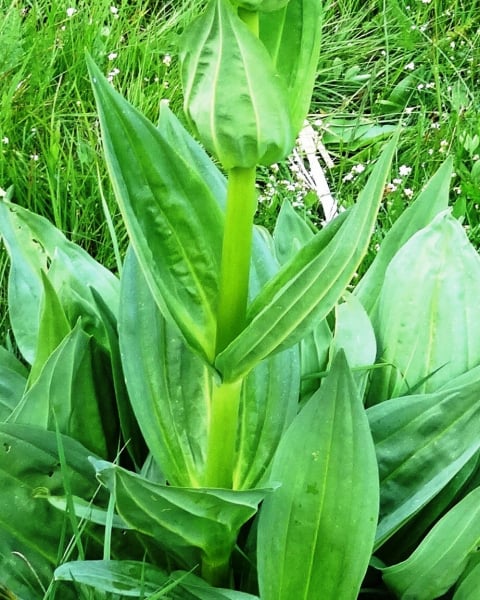
Great yellow gentian
Gentiana lutea
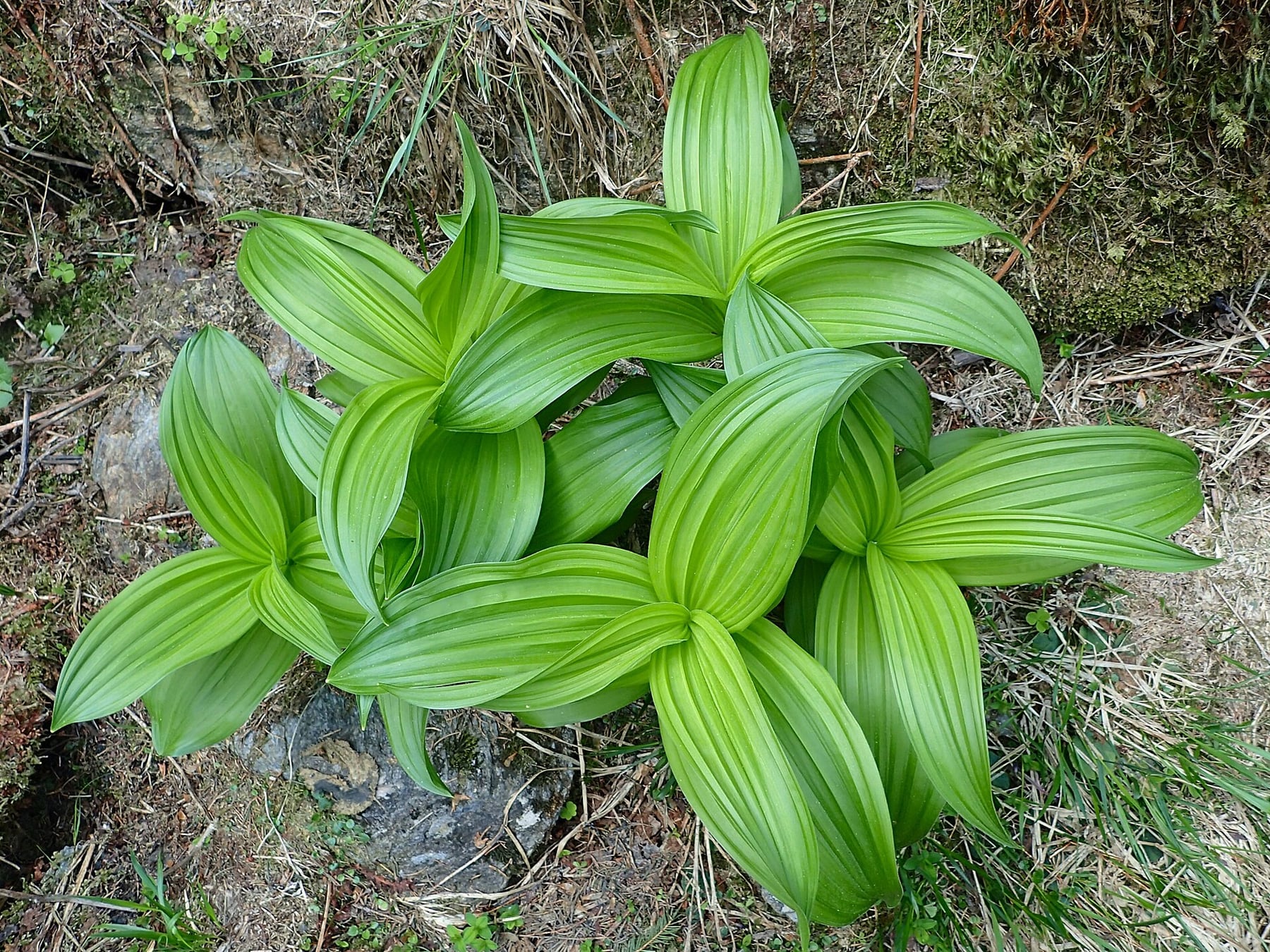
White false hellebore
Veratrum album

A dangerous and well-documented confusion, especially when not in flower and only the leaves are visible: great yellow gentian has opposite leaves, whereas white false hellebore has alternate leaves, pleated lengthwise. In flower, the gentian has large bright yellow star-shaped flowers in whorls, whereas the false hellebore has small whitish to greenish flowers in long panicles. These are good clues, but none is a guarantee on its own: if in the slightest doubt about a root or a plant not in flower, never eat it.

🍃 Leaves
Broad, ovate, opposite, with several clearly marked arching main veins, grey-green.
Large, alternate, ovate-lanceolate, longitudinally pleated (very prominent parallel veins), sheathing at the base
🌸 Flowers
Bright yellow stars grouped in tiered whorls along the stem
White to yellowish-green, small, arranged in long terminal panicles of 30 to 60 cm
🍎 Fruits
Elongated capsules containing many winged seeds
Three-chambered capsule containing winged seeds
🪵 Bark
Very deep taproot, basal clump
Perennial herbaceous plant with a sturdy, upright, unbranched stem
📏 Size
50 cm to 1.5 m tall
0.5 to 1.5 m tall
🗺️ Habitat
Mountain meadows, gardens, rich, deep soils
Damp meadows and mountain pastures (Alps, Pyrenees, Massif Central, Jura, Vosges), 700 to 2000 m
⚠️ Toxicity
No known toxicity, bitter root traditionally used in liqueur-making and aperitifs.
Extremely toxic in all parts, especially the root. Contains powerful steroidal alkaloids (protoveratrine, jervine, cevadine, veratridine) causing violent vomiting and serious cardiac and neurological disorders; ingestion can be fatal. Never eat a root or non-flowering plant resembling great yellow gentian without absolute certainty of identification.
🔎 And from the White false hellebore side
A dangerous and well-documented confusion, especially outside flowering when only the leaves are visible: white false hellebore has alternate, longitudinally pleated leaves, whereas great yellow gentian has opposite leaves. In flower, the false hellebore has small whitish to greenish flowers in long panicles, whereas the gentian has large bright yellow star-shaped flowers in whorls. These are good clues, but none is a guarantee on its own: if in the slightest doubt about a root or a non-flowering plant, never eat it.
🌿 Go further

Want to practise spotting these details on real photos? Floraneo offers profiles and quizzes for dozens of look-alike species.

ℹ️ Educational profile — do not use it to judge whether a plant is edible or safe.