Leaf
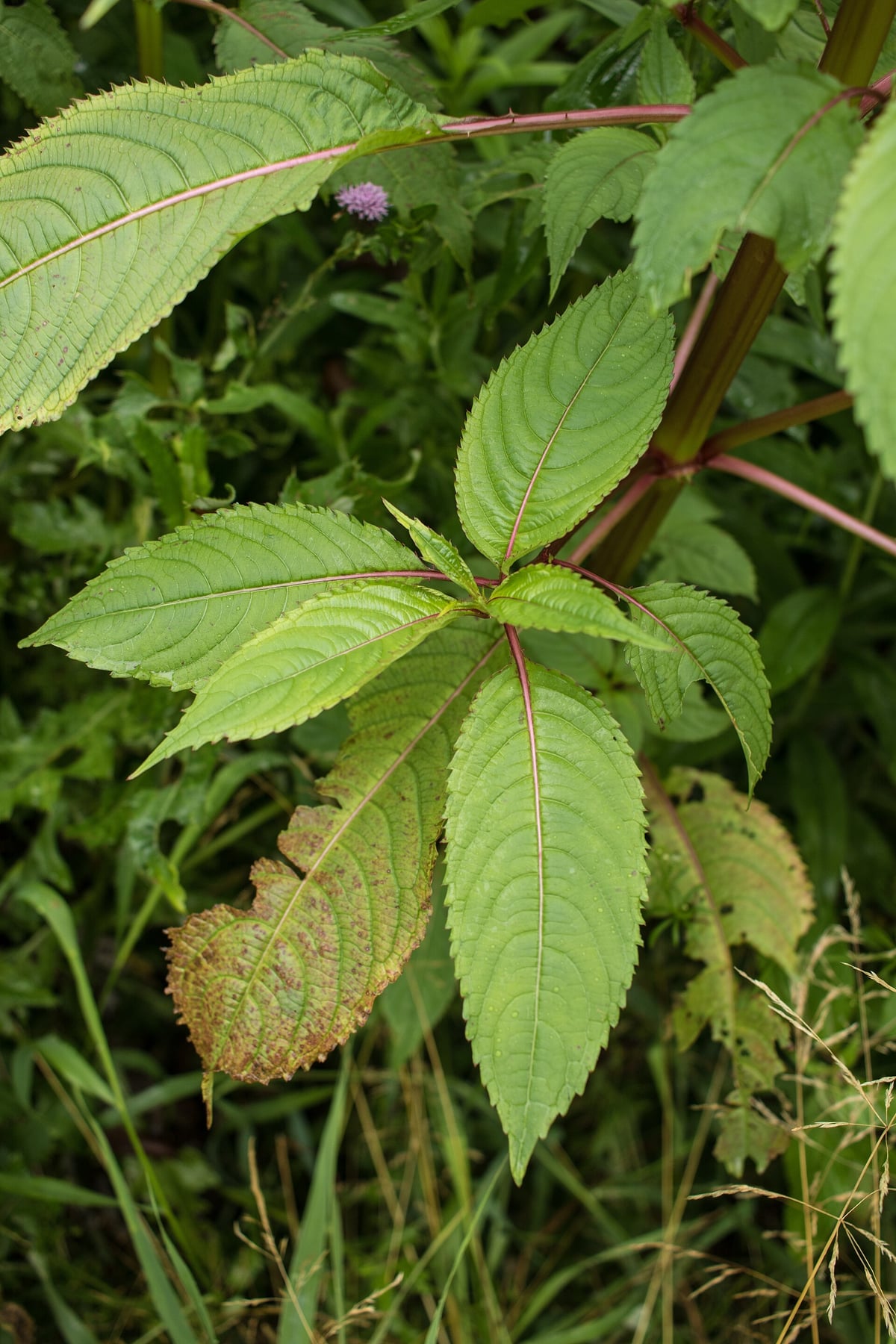
Donald Hobern from Copenhagen, Denmark, Wikimedia · CC BY 2.0
Himalayan balsam
Impatiens glandulifera Royle
Also known as: Policeman's helmet
Family: Balsaminaceae
- 1 to 3 m tall
- Riverbanks, ditches, wet woodland and cool wasteland
- Part shade, Full sun
- Annual: dies at the first frosts, its seeds survive the winter
In flower from July to October
4 months❓ How do you recognise this plant?
When ripe, its capsules burst at the slightest touch and throw the seeds several metres: hence its Latin name 'impatiens', and its ease in colonising riverbanks.
🍃 Leaves
Opposite or in whorls of 3, lance-shaped, finely toothed, 6 to 25 cm long, with a reddish midrib and small glands at the base of the blade
🌸 Flowers
Helmet-shaped flowers, pink to purple (sometimes white), with a curved spur, in clusters at the leaf bases; strong, sweet scent
🍎 Fruits
Elongated five-valved capsules that burst at the slightest contact, throwing the seeds several metres
🪵 Bark
Hollow, fleshy, reddish stem with swollen nodes (annual herbaceous plant)
Distribution, pollinators, uses
🗺️ Distribution
Native to the western Himalaya; introduced to Europe in 1839 as an ornamental plant
🐝 Value for pollinators
Nectar-rich flowers heavily visited by bumblebees and bees, to the point of competing with native plants
✂️ Horticultural uses
Invasive alien species of riverbanks, not to be planted; pulling it up before the seeds form limits its spread
⚠️ Possible toxicity
No notable toxicity known
ℹ️ Educational profile — do not use it to judge whether a plant is edible or safe.
🌱 This database is constantly evolving — species and information are added and corrected regularly. Spotted a mistake? Report it below.
© Floraneo — profile content is protected; reproduction without permission is prohibited. Photos remain under their own licence (see the credit shown on each photo).